
Call Us: (612) 220-0101
Start the Process
(612) 220-0101

Summer Outdoor Entertaining: How to Design Your Backyard for Hosting in Minnesota

By Charlie Kraemer | May 26, 2026 | 10 min read

Minnesota's outdoor season is short and precious -- roughly 20 weeks from late May through mid-October when the weather cooperates for outdoor hosting. A thoughtfully designed backyard entertaining space lets you maximize every one of those weeks, turning your property into the gathering place your family and friends gravitate to all summer long. The difference between a backyard that gets used occasionally and one that becomes the default weekend destination comes down to design: flow, comfort, shade, and atmosphere.

This guide covers the essential elements of a backyard built for summer entertaining in the Lake Minnetonka area, from patio sizing and layout to shade structures, fire features, and the lighting that keeps the party going well past sunset.

Start With the Patio: Size, Shape, and Flow

The patio is the foundation of every outdoor entertaining space. It defines the footprint of your outdoor room and dictates how guests move, gather, and interact. Getting the size right is the single most important planning decision.

How Big Should Your Entertaining Patio Be?

The rule of thumb is 25 square feet per guest for comfortable entertaining. A patio designed for 12 to 16 guests needs 300 to 400 square feet of open space, plus additional area for a grill station, fire feature, or bar. Most entertaining patios we build in Shorewood, Minnetonka, and Wayzata are 400 to 600 square feet, with larger lakefront properties going up to 800 or more.

Undersizing is the most common regret. A patio that feels spacious when empty becomes cramped with a dining set, lounge chairs, and 12 people. Plan for your maximum guest count, not your typical weeknight use. You will never regret having more space, but you will absolutely notice when there is not enough.

Multi-Zone Layout

The best entertaining patios are not one big flat rectangle. They are organized into distinct zones that create natural flow and purpose. Think of it like rooms in a house -- each zone has a function, and the transitions between them guide guests from one activity to the next.

Dining zone. Positioned closest to the house for easy kitchen access. A 10-by-12 foot area accommodates an 8-person table with room for chairs to pull out and servers to pass behind. For larger gatherings, a built-in stone or concrete counter with bar stools adds flexible seating without consuming table space.

Lounge zone. Set slightly apart from dining -- even 3 to 4 feet of elevation change or a different paver pattern creates visual separation. Deep-seating sofas and club chairs around a low coffee table invite the after-dinner conversation that is the real purpose of a good gathering. This is where guests settle in for hours.

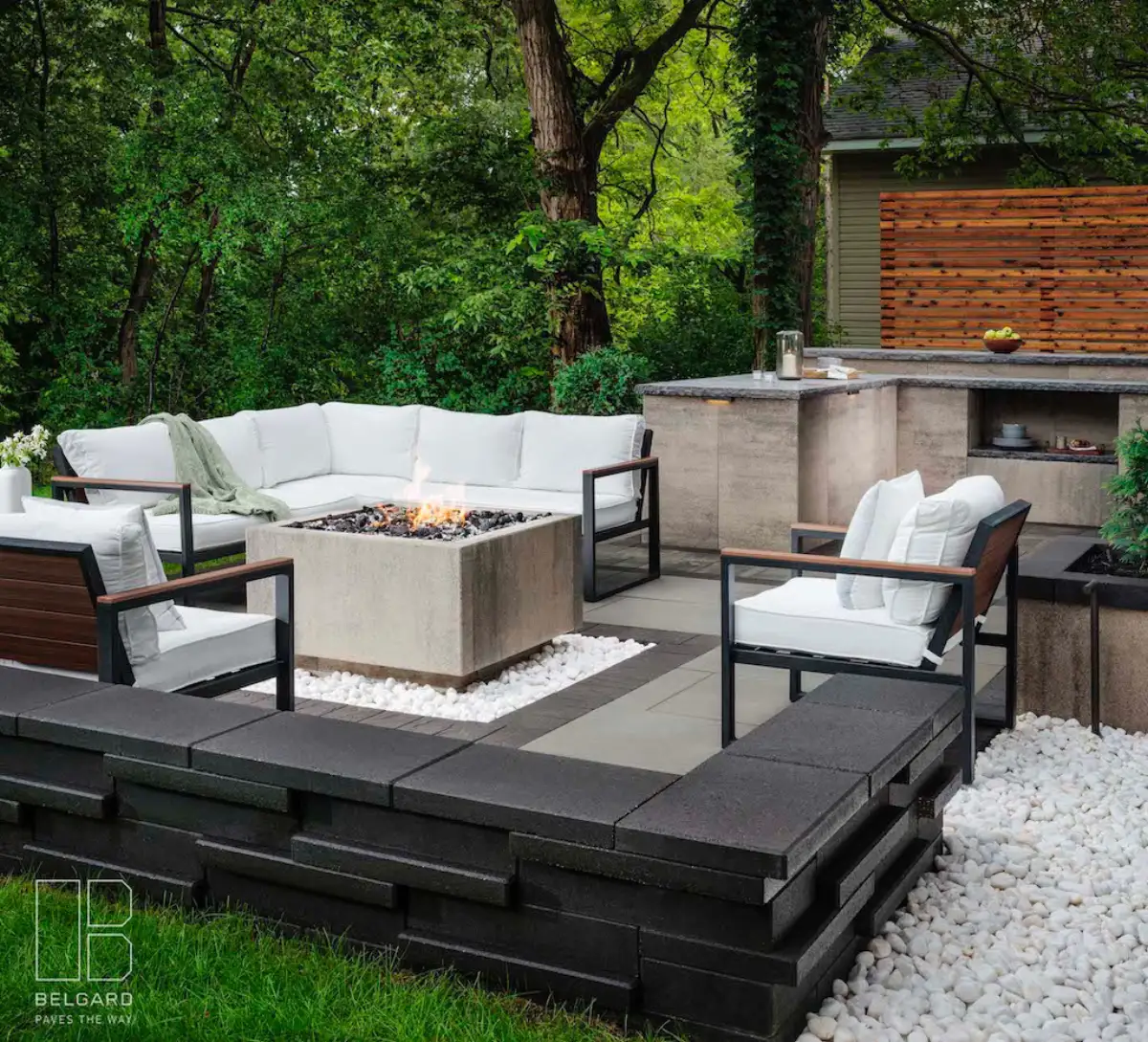
Fire zone. The fire feature is the natural anchor point for evening entertaining. Whether it is a built-in gas fire pit or a dedicated fireplace, position it where sightlines are good from both the dining and lounge zones but far enough away that heat does not compete with the dining experience. Our fire pit planning guide covers material options, gas versus wood-burning, and seating arrangements in detail.

Activity zone. For families, a lawn area adjacent to the patio for yard games -- cornhole, bocce, croquet -- keeps kids and adults entertained during long summer gatherings. This does not need to be hardscaped; a well-maintained turf area next to the patio works perfectly.

Shade: The Feature That Extends Your Outdoor Season

In Minnesota, shade is not optional for summer entertaining. Afternoon sun from May through August creates surface temperatures on exposed patios that make sitting uncomfortable. A pergola or shade structure transforms your patio from a space you use on cooler days to one that works all summer long, including the hottest July afternoons.

Pergola Options

A pergola over your dining or lounge zone provides the most impactful shade solution. For entertaining, we recommend covering at least the dining zone so guests can eat comfortably regardless of sun position. The lounge zone benefits from partial shade -- an open-rafter pergola that filters light while maintaining airflow.

Aluminum louvered roof systems are the premium choice for entertaining pergolas because the louvers adjust from fully open to fully closed. Open position provides filtered shade with full breeze. Closed position blocks rain entirely, meaning a passing summer shower does not end the party. This flexibility alone justifies the higher cost for homeowners who entertain frequently.

Ceiling fans integrated into the pergola structure are underrated. They circulate air on humid Minnesota evenings, discourage mosquitoes, and make covered spaces feel 5 to 10 degrees cooler. Plan the electrical rough-in during construction, not after.

Fire Features: Extending the Evening

A fire feature does two things for entertaining: it provides warmth that extends your outdoor season from May-September to May-October, and it creates an atmosphere that nothing else replicates. There is a reason humans have gathered around fires for thousands of years. It is the most natural social anchor in any outdoor space.

For entertaining, gas fire pits offer practical advantages. They ignite instantly, produce no smoke to blow in guests' faces, require no wood storage or ash cleanup, and turn off with a switch when the last guest leaves. A 42 to 48-inch round gas fire pit with a surrounding seat wall provides seating for 6 to 8 people without additional furniture.

The seat wall itself is a design opportunity. Built from the same stone or paver material as your patio, it creates an integrated look while providing permanent seating that requires no seasonal storage. Add 18 to 20 inches of width for comfortable seating depth, and cap the wall with a smooth stone or concrete surface.

A dedicated outdoor fireplace makes a statement on larger properties and provides more heat directionality than a fire pit. It also works as a dramatic focal point visible from inside the house, adding visual interest year-round. Position it on the far side of the patio so the chimney does not block views from the house.

Landscape Lighting: The Difference Between Good and Unforgettable

Landscape lighting is the single feature that most dramatically transforms an outdoor entertaining space, and it is the one most homeowners underinvest in. Proper lighting extends your usable outdoor hours by 3 to 4 hours per evening and creates an atmosphere that daytime simply cannot match.

Lighting Layers for Entertaining

Task lighting. Over the dining table and grill station, you need enough light to see food and faces. Downlights mounted on a pergola beam or pendant fixtures provide focused illumination without the harsh wash of floodlights. Dimmable fixtures let you adjust from dinner-bright to conversation-dim as the evening progresses.

Ambient lighting. String lights across the pergola or between posts create the warm, inviting glow that defines outdoor entertaining atmosphere. LED string lights on a timer are the simplest, most effective ambient lighting option. Run them in parallel lines, not random drapes, for a clean look.

Accent lighting. Uplights on mature trees and plantings surrounding the patio create depth and drama. A well-lit tree canopy overhead makes the entire outdoor space feel like a room rather than just a lit patio in a dark yard. Path lights along walkways leading to and from the patio provide safety and visual guidance.

Feature lighting. A fire feature provides its own light, but additional accent lighting on the fire pit surround or fireplace face adds dimension. Underwater LED lights in a water feature, if you have one, create a focal point that draws attention from across the yard.

Privacy Screening: Creating an Enclosed Feel

A great entertaining space feels private even if you have close neighbors. In the Lake Minnetonka area, properties in Deephaven, Excelsior, and established Minnetonka neighborhoods often have adjacent homes within clear sightlines of the patio area.

Privacy plantings are the most natural solution. A row of Green Giant arborvitae or Techny arborvitae along one or two sides of the patio provides year-round screening that matures into a dense, green wall within 3 to 5 years. For faster results, start with 6 to 8-foot specimens that provide immediate screening at planting.

For tighter spaces where plantings take up too much footprint, a low retaining wall topped with a built-in planter creates vertical screening in just 18 inches of depth. Combined with ornamental grasses or tall perennials, this approach provides summer privacy in a fraction of the space.

Summer Entertaining Features Worth the Investment

Beyond the foundation elements, these features separate a good entertaining space from a great one:

Outdoor audio. Weatherproof speakers built into the landscape or mounted under the pergola let you control music for the entire outdoor area. Wired landscape speakers outperform portable Bluetooth speakers in coverage and sound quality by a wide margin. Run speaker wire during hardscaping construction to avoid tearing up finished surfaces later.

Outdoor kitchen or grill station. A built-in grill, refrigerator, and countertop eliminate the back-and-forth trips to the indoor kitchen that pull the host away from guests. Even a modest 8-foot L-shaped station with a built-in grill and 3 feet of counter space changes the hosting experience entirely. The cook stays in the conversation.

Mosquito management. Minnesota summers mean mosquitoes, and nothing kills a gathering faster than aggressive bugs. Integrated misting systems around the patio perimeter provide reliable suppression. Natural approaches -- mosquito-repelling plantings like catmint and citronella geraniums along the patio edge, combined with fans for airflow -- reduce mosquito pressure without chemicals.

Drainage engineering. A patio that puddles after a summer rain becomes a problem space, not an entertaining space. Proper grading, a compacted aggregate base, and permeable paver options ensure water moves away from the entertaining area quickly. This is engineering that happens during construction and never requires attention afterward -- but it must be planned from the start.

Budgeting Your Entertaining Space

Outdoor entertaining spaces in the Lake Minnetonka area range widely based on size, materials, and features. Here are realistic budgets for 2026:

Essential setup (400 sq ft paver patio, gas fire pit, basic landscape lighting): $35,000 to $55,000. This gets you a functional, attractive entertaining space with the core elements. See our patio cost guide for a detailed material breakdown.

Complete entertaining space (600 sq ft patio, pergola, fire pit, full lighting package, privacy plantings): $65,000 to $100,000. This is the sweet spot for most Lake Minnetonka homeowners who entertain regularly and want a polished, multi-zone space.

Premium outdoor room (800+ sq ft patio, louvered pergola, fireplace, outdoor kitchen, professional lighting, heaters): $100,000 to $150,000+. For homeowners who want their outdoor space to rival the best restaurants they have visited. Our project investment guide breaks down where each dollar goes.

Frequently Asked Questions

How much does a backyard entertaining space cost in Minnesota?

A complete outdoor entertaining space in the Lake Minnetonka area typically costs $40,000 to $120,000 depending on size, materials, and features. A basic setup with a paver patio, fire pit, and landscape lighting starts around $35,000. Adding a pergola, outdoor kitchen, and premium hardscaping pushes the budget to $80,000 or more. Every project is custom -- see our investment guide for detailed ranges.

What is the best patio size for entertaining?

Plan 25 square feet per guest for comfortable entertaining. A patio for 12 to 16 guests needs 300 to 400 square feet minimum, plus additional space for a grill station, fire feature, or bar area. Most entertaining patios in the Lake Minnetonka area are 400 to 600 square feet, with larger lakefront properties going up to 800 or more.

Can you entertain outdoors in Minnesota in October?

Yes -- October is one of the best entertaining months in Minnesota when you design for it. A pergola with a louvered roof blocks wind and light rain. Infrared heaters mounted on the pergola beams keep guests comfortable down to 45 degrees. A fire feature provides both warmth and ambiance. With these elements, most homeowners extend outdoor entertaining from May through late October, adding 6 to 8 weeks beyond the typical summer season.

Ready to Design Your Entertaining Space?

We design and build complete outdoor entertaining spaces across the Lake Minnetonka area. Every project starts with a design consultation to understand your property, how you entertain, and what matters most for your family.

Start the Process