
Deck vs Patio in Minnesota: Which Should You Build?
By Charlie Kraemer | May 19, 2026 | 10 min read
For most Minnesota homeowners, a paver patio is the better long-term investment, but a deck is the better choice when your home sits significantly above grade or you need a surface directly off an upper-level door. The right answer depends on your property's topography, how you plan to use the space, and whether you are building a standalone surface or part of a larger outdoor living design. After 30 years of building both across the Lake Minnetonka area, here is how the two compare in the categories that actually matter.
Cost Comparison: What You Will Actually Pay in 2026
Cost is usually the first question, and in Minnesota the numbers favor patios in almost every scenario. Here is what homeowners in the Minnetonka, Wayzata, and Eden Prairie area should expect for a professionally installed 400-square-foot project:
Paver patio: $15,200 to $24,800 ($38 to $62 per square foot). This includes excavation, compacted gravel base, polymeric sand, edge restraints, and premium Belgard pavers. Site access, drainage complexity, and pattern choice affect where you fall in that range. For a deeper breakdown, see our patio cost guide.
Composite deck: $18,000 to $34,000 ($45 to $85 per square foot). Composite decking like Trex or TimberTech is the standard for new deck construction in Minnesota because it resists the rot, splitting, and warping that destroy wood decks in our climate. The price includes framing, footings, decking, railing, and stairs.
Pressure-treated wood deck: $10,000 to $18,000 ($25 to $45 per square foot). Lower upfront cost, but wood decks in Minnesota need staining or sealing every 1 to 2 years and typically require board replacement within 10 to 15 years. When you factor in lifetime maintenance, the total cost approaches composite.
According to the National Association of Realtors' 2025 Remodeling Impact Report, a new patio recoups approximately 95% of its cost at resale, while a wood deck recoups roughly 75%. Composite decks fall between the two. In the Lake Minnetonka market, where outdoor living spaces are expected on premium properties, both additions increase buyer interest significantly.
Durability in Minnesota's Climate
Minnesota is one of the hardest environments in the country for outdoor structures. The combination of 42+ pounds per square foot snow loads, 100-plus freeze-thaw cycles per year, intense summer UV, and occasional severe storms tests every material choice.
How Patios Hold Up
A properly installed paver patio is engineered to handle Minnesota's freeze-thaw cycling. The compacted gravel base allows water to drain below the frost line rather than pooling beneath the surface. Individual pavers flex independently, preventing the large-scale cracking that destroys poured concrete slabs in Minnesota. Well-built paver patios last 25 to 50 years before needing significant work, and even then, individual pavers can be lifted and reset rather than tearing out the entire surface.
The critical factor is base preparation. In the Lake Minnetonka area, where clay soils dominate, we excavate 8 to 12 inches and install a compacted Class 5 gravel base to ensure proper drainage and prevent heaving. Skipping this step is the single most common reason patios fail in Minnesota.
How Decks Hold Up
Composite decks handle Minnesota weather well at the surface level. Modern composites resist fading, staining, mold, and moisture damage. The structural framing underneath, however, is still typically pressure-treated lumber, which is subject to the same rot and degradation as any wood in a wet, cold climate. Proper flashing at the ledger board connection (where the deck attaches to the house) is absolutely critical. A failed ledger connection is the number one cause of deck collapses in Minnesota, and it typically results from moisture trapped behind inadequate flashing.
Wood decks require the most maintenance of any outdoor surface in Minnesota. Annual power washing, stain or sealant application every 1 to 2 years, and regular inspection for rot, loose fasteners, and structural deterioration are all part of the maintenance cycle. Even with diligent maintenance, most wood decks in the Twin Cities metro need major repairs or full replacement within 15 to 25 years.
Maintenance: The Ongoing Cost Nobody Talks About
Upfront cost gets all the attention, but maintenance is where the real cost difference between decks and patios shows up over 20 years.
Paver patio annual maintenance: Blow or sweep debris, occasional polymeric sand reapplication (every 3 to 5 years, roughly $200 to $500), and weed management at the edges. Total annual cost: under $100 in most years. Time investment: a few hours per season.
Composite deck annual maintenance: Wash with soap and water or a composite deck cleaner 1 to 2 times per year. No staining or sealing required. Inspect railing connections and structural framing annually. Total annual cost: $50 to $150. Time investment: half a day per year.
Wood deck annual maintenance: Power wash, stain or seal (professional application runs $500 to $1,200 for a 400-square-foot deck), inspect and replace damaged boards, check all structural connections. Total annual cost: $500 to $1,500. Time investment: a full weekend or a professional crew for a day. Over 20 years, that adds up to $10,000 to $30,000 in maintenance costs alone.
When a Patio Is the Better Choice
A patio is the stronger option in most situations, but especially when:
Your yard is at or near the same level as your home's main floor. If you can step out a door and walk onto grade with little or no elevation change, a patio eliminates the expense and maintenance of an elevated structure. This is the most common scenario for ranch homes and walkout basements across Minnetonka, Plymouth, and Eden Prairie.
You want a fire pit or fireplace. Open flames and wood or composite decking are a dangerous combination. Gas fire tables can be installed on decks with proper heat shielding, but built-in fire pits and fireplaces require a non-combustible surface. A paver patio is the natural base for any fire feature.
You are planning a complete outdoor living space. When the project includes a patio, retaining walls, landscape lighting, plantings, and a fire feature, the patio becomes the foundation of a cohesive design. Hardscape elements integrate with each other visually and structurally in ways that a deck-based design cannot match.
Long-term value is the priority. With a 25 to 50 year lifespan, minimal maintenance costs, and strong resale value, a paver patio delivers the lowest total cost of ownership of any outdoor surface option in Minnesota.
When a Deck Is the Better Choice
Decks solve specific problems that patios cannot:
Your home sits well above grade. Many homes in Shorewood, Deephaven, and along the Lake Minnetonka shoreline sit 4 to 8 feet above the yard. Building a patio at that elevation would require massive retaining walls and fill, often costing more than a deck. A deck bridges the gap between the door and the yard efficiently.
You need a surface directly off an upper-level door. Second-story decks, balcony-style decks off bedrooms, and decks off elevated walkout levels are applications where a patio is not structurally possible without significant earthwork.
You want a warm underfoot surface. Composite and wood decking stay more comfortable underfoot than pavers or stone on hot summer days. This matters for barefoot areas near pools, hot tubs, and lakefront access points.
Tree root systems limit excavation. If mature trees surround the project area, excavating for a patio base can damage root systems. A deck's post-and-pier foundation requires only small, localized footings that minimize disruption to established trees.
The Best of Both: Deck-Patio Combinations
For many Lake Minnetonka properties, the answer is not deck or patio. It is both. A deck-patio combination solves the elevation problem while still providing a ground-level hardscape surface for fire features, dining, and entertaining.
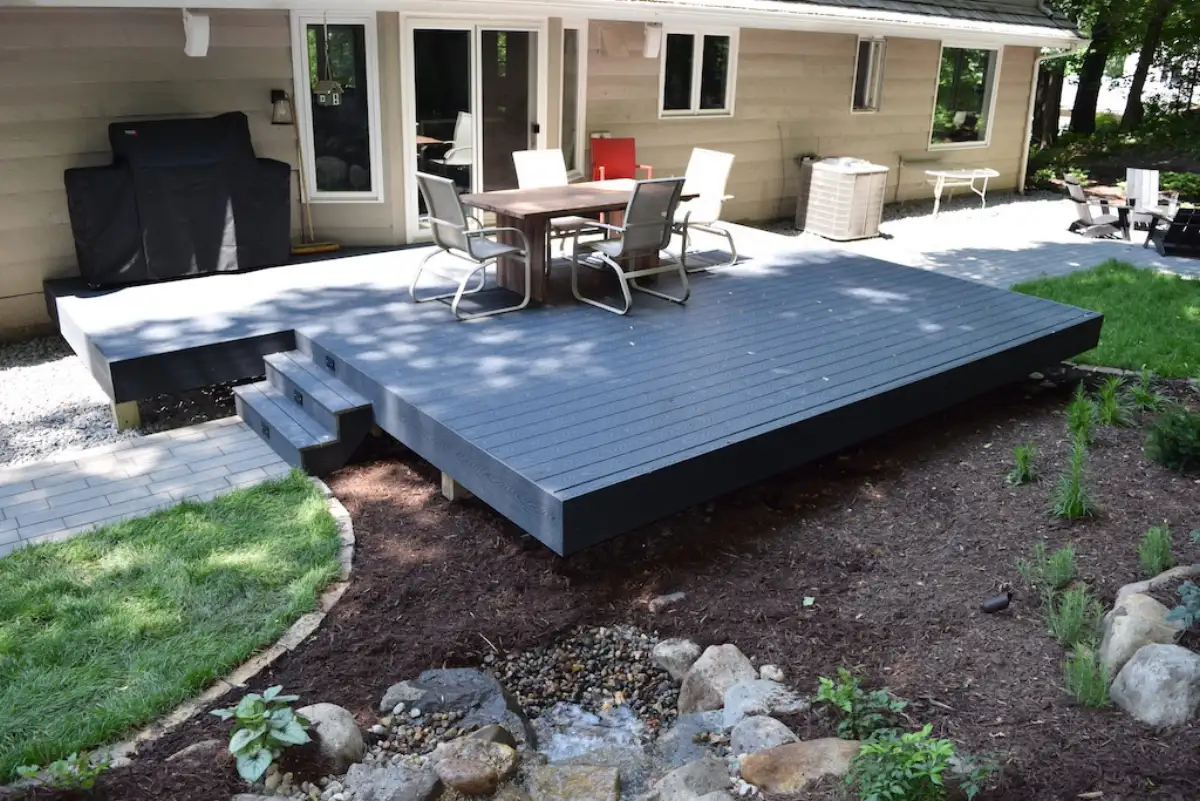
The typical approach: a composite deck attached to the home at door level, with stairs stepping down to a paver patio at grade. The deck provides the transition from indoors to outdoors, and the patio provides the main living and gathering space. Retaining walls, landscape lighting, and planting beds tie the two levels together into a unified design.
This is the approach we build most often for homes with moderate elevation changes (2 to 5 feet from door to grade). It gives homeowners the benefits of both surfaces while creating natural zones for different activities. The deck becomes the grilling and morning coffee zone. The patio becomes the evening fire and entertaining zone.
Minnesota Building Code Considerations
Both decks and patios require attention to local building codes, but the requirements are different:
Decks require a building permit in virtually every Lake Minnetonka area municipality. Minnesota residential code requires footings to extend 42 inches below grade (the frost line), ledger board connections must meet current flashing and fastening standards, and railings are required on any deck surface 30 inches or more above grade. Inspections are required at the footing, framing, and final stages.
Patios typically do not require a building permit if they are ground-level, freestanding (not attached to the home), and do not alter drainage patterns that affect neighboring properties. However, if your patio project includes retaining walls over 4 feet in exposed height, any attached structures like a pergola, or electrical work for lighting, those elements will trigger permit requirements.
We handle permitting as part of every project, because the requirements vary between Minnetonka, Wayzata, Shorewood, Excelsior, and the other Lake Minnetonka communities we serve. Getting this right upfront prevents costly delays and rework.
Frequently Asked Questions
Is it cheaper to build a deck or a patio in Minnesota?
A patio is typically cheaper. Paver patios in the Lake Minnetonka area cost $38 to $62 per square foot installed, while composite decks range from $45 to $85 per square foot. A 400-square-foot paver patio averages $15,200 to $24,800, compared to $18,000 to $34,000 for a comparable composite deck. Wood decks using pressure-treated lumber start lower at $25 to $45 per square foot, but lifetime maintenance costs close the gap.
Which lasts longer in Minnesota weather: a deck or a patio?
A properly installed paver patio lasts 25 to 50 years or more with minimal maintenance. Composite decks last 25 to 30 years, while wood decks typically last 15 to 25 years before needing significant repair or replacement. Minnesota's freeze-thaw cycles, heavy snow loads, and UV exposure are harder on elevated wood structures than on ground-level hardscape.
Can you combine a deck and patio on the same property?
Yes, and this is one of the most popular approaches for Lake Minnetonka area homes. A common design uses a deck attached to the house at door level, stepping down to a paver patio at grade. This creates distinct outdoor zones while solving the elevation difference between the home's floor level and the yard. See our investment guide for how combined projects fit into different budget tiers.
Not Sure Which Is Right for Your Property?
We design and build both decks and patios as part of complete outdoor living spaces across the Lake Minnetonka area. Every project starts with a site visit to evaluate your property's topography, soil conditions, and elevation, so we can recommend the right approach for your home and budget.
Start the Process